

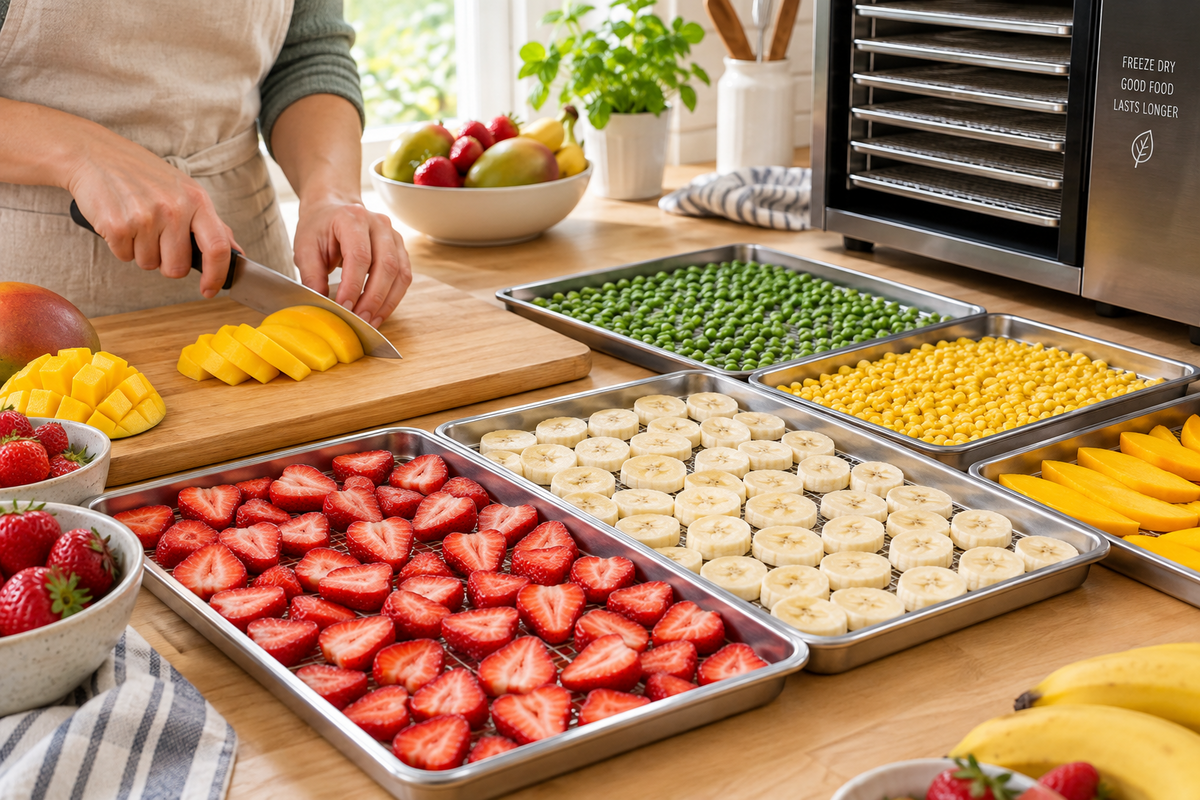
Good freeze-drying results start before the food goes into the machine.
How you cut, cook, blanch, pre-freeze, and arrange food on the trays can affect:
-
How evenly the food freezes
-
How long the batch takes
-
Whether thick pieces dry completely
-
Final texture and appearance
-
How well the food rehydrates later
For most foods, the basic preparation principles are simple:
-
Start with good-quality food and clean equipment.
-
Prepare foods as you normally would for eating, freezing, or cooking.
-
Cut pieces into relatively small, uniform sizes.
-
Blanch vegetables when appropriate.
-
Cook foods that require cooking for safety.
-
Pre-freeze when it makes sense for your food or workflow.
-
Arrange food in an even layer on the trays.
-
Avoid unnecessarily thick portions or overloaded trays.
Utah State University recommends small, uniform pieces, ideally no more than about ½ inch thick for many foods, and notes that pre-freezing can help food dry faster and more evenly. It also emphasizes that freeze drying does not kill bacteria, so sanitation and safe food preparation remain important.
Quick Answer: How Should You Prepare Food for Freeze Drying?
Prepare food so that water can freeze and escape as evenly as possible.
That usually means:
Wash and prepare the food appropriately → cut it into uniform pieces → cook or blanch when needed → spread it evenly on the trays → pre-freeze if desired → begin the freeze-drying cycle.
The exact preparation depends on the food.
A strawberry, bowl of chili, steak, scrambled eggs, green beans, and yogurt all have different structures and preparation considerations.
The goal isn't to force every food into one preparation method. It's to prepare each food in a way that helps it freeze dry evenly and completely.

Why Food Preparation Matters
A freeze dryer can automate much of the freeze-drying cycle, but the way you prepare the food still matters.
Imagine one tray containing:
-
Thin apple slices
-
Large apple quarters
-
A thick piece of fruit
-
Small diced pieces
The smallest pieces may become dry while the thickest piece still contains moisture internally. That's because water has farther to travel from the center of a large piece.
Preparation therefore affects more than appearance. It influences how efficiently moisture can move out of the food during the drying process.
Uniform preparation helps reduce those differences.
Start With Good-Quality Food
Freeze drying is a preservation process. It doesn't improve poor-quality food.
Whenever possible, begin with food that is:
-
Fresh
-
Properly stored
-
Free from spoilage
-
Prepared using clean utensils and surfaces
If produce has bruised or damaged areas, trim them appropriately before processing.
For foods that require refrigeration, maintain appropriate temperature control during preparation.
Most importantly:
Freeze drying does not make unsafe food safe.
Bacteria can survive freeze drying and become active again after rehydration. Treat the food entering your freeze dryer with the same food-safety care you would use if you were serving it today.
Clean hands, clean surfaces, safe temperatures, and proper cooking still matter.
Related Learning Center guide: Does Freeze Drying Kill Bacteria? Food Safety Explained
Should You Wash Food Before Freeze Drying?
Fresh fruits and vegetables should generally be cleaned as appropriate before preparation.
Wash produce before cutting it so you aren't unnecessarily moving contamination from the outside surface into the food with your knife.
Then:
-
Remove stems or unwanted leaves
-
Peel if appropriate
-
Remove damaged areas
-
Pit or core foods when necessary
-
Cut to the desired size
For some fruits, pretreatments such as ascorbic acid or lemon juice may help reduce browning.
The preparation doesn't have to be complicated. The main goal is to prepare the food in the form you expect to use later.
How Thick Should Food Be for Freeze Drying?
This is one of the most useful preparation rules:
Keep pieces relatively small and uniform.
Utah State University's home freeze-drying guidance recommends cutting food into uniform pieces, ideally no more than about ½ inch thick for many foods, to encourage even freezing and drying.
That doesn't mean every food must be exactly ½ inch thick. The important thing is the principle.
Compare:
Tray A: Ten strawberry slices of similar thickness.
Tray B: Six thin slices, two halves, and two whole strawberries.
Tray A gives the freeze dryer a much more consistent drying job. The larger pieces on Tray B are likely to require more time.
Why does uniform thickness help?
Moisture from the center of the food has to travel outward.
The thicker the food, the farther that moisture has to move. Uniform thickness makes it more likely that the pieces on the tray will finish at roughly the same time.

Can You Freeze Dry Whole Foods?
Sometimes, but preparation can make a major difference. Small foods may work whole, particularly when their structure allows moisture to escape. Other foods benefit from: Slicing, Dicing, Halving, Piercing or breaking skins when appropriate. Removing pits or cores. A whole grape, blueberry, cherry tomato, or other small fruit.
Should You Pre-Freeze Food Before Freeze Drying?
Pre-freezing is not required for every batch, but it can be useful.
Starting with frozen food can shorten the amount of time the freeze dryer needs to spend freezing the food before the drying process begins. Pre-freezing can also be helpful for managing your workflow.
For example, you can:
-
Prepare food when you have time.
-
Load it onto trays.
-
Freeze the trays.
-
Run the freeze dryer later.
This can be especially convenient during:
-
Bulk food purchases
-
Meal prep
-
Large cooking projects
-
Periods when the freeze dryer is already running another batch
Should food be frozen on the trays?
That can be a convenient approach if you have freezer space.
Keeping food arranged on the trays avoids having pieces freeze into a large block that must be separated later.
If you pre-freeze food in another container, make sure you can still arrange it appropriately on the trays before the freeze-drying cycle begins.
Does pre-freezing make every batch faster?
Not necessarily by the exact same amount.
Cycle time depends on more than starting temperature. Factors include:
-
Water content
-
Food thickness
-
Sugar content
-
Density
-
Amount loaded
-
Food structure
Pre-freezing means the freeze dryer doesn't have to do as much work during the initial freezing stage, but it doesn't change the amount of water that ultimately needs to be removed.
Think of pre-freezing as a useful preparation and workflow option, not a guaranteed shortcut for every batch.
Do Vegetables Need to Be Blanched Before Freeze Drying?
Many vegetables benefit from blanching before long-term preservation.
Blanching briefly exposes vegetables to boiling water or steam and then cools them rapidly.
The purpose isn't primarily to cook the vegetable. It helps deactivate enzymes that can continue causing changes in:
-
Flavor
-
Color
-
Texture
-
Quality during storage
Utah State University recommends blanching or steaming vegetables when appropriate before freeze drying. Freezing alone slows enzyme activity but doesn't necessarily stop it.
Does every vegetable need blanching?
No.
Some vegetables are commonly preserved without blanching. For example, peppers and onions may be frozen without blanching.
So rather than saying:
“Always blanch vegetables.”
A better rule is:
Check the preparation recommendation for the particular vegetable you're preserving.
How Do You Blanch Vegetables?
The exact blanching time depends on the vegetable and the size of the pieces.
The general process is:
-
Prepare and cut the vegetable.
-
Place it in boiling water or expose it to steam for the recommended amount of time.
-
Cool it quickly to stop the heating process.
-
Drain thoroughly.
-
Arrange it on freeze dryer trays.
-
Pre-freeze if desired.
Different vegetables require different blanching times. Avoid simply using the same time for every vegetable.
Too little blanching may not adequately inactivate enzymes, while too much can affect texture, flavor, color, and nutrients.
Should Fruit Be Blanched?
Usually not in the same way as most vegetables.
Fruit preparation more commonly focuses on:
-
Washing
-
Peeling if desired
-
Removing pits or cores
-
Cutting evenly
-
Preventing browning when necessary
Light-colored fruits such as apples, peaches, and pears can experience enzymatic browning after cutting. An appropriate pretreatment may help maintain color.
But don't assume every fruit needs pretreatment. Strawberries and blueberries, for example, have different preparation needs from sliced apples.

Should Meat Be Cooked Before Freeze Drying?
Freeze drying does not cook food or kill bacteria.
Meat can be freeze dried raw, but if it is, it should continue to be treated as raw meat and cooked appropriately before eating.
For foods that you want to be ready to rehydrate and eat, cooking meat before freeze drying is often the simpler approach.
Cooked meat can be:
-
Diced
-
Sliced
-
Shredded
-
Crumbled
-
Incorporated into complete meals
For example, ground beef can be cooked, broken into relatively uniform pieces, drained of excess liquid or fat as appropriate, and spread evenly on the trays.
Foods with substantial amounts of fat can have different storage characteristics because freeze drying removes water, not fat. Leaner preparations are often easier to manage for longer-term storage.
How Should You Prepare Eggs?
Egg preparation depends on how you plan to use them later.
Cooked scrambled eggs and other cooked egg dishes can be freeze dried for convenient future meals.
If eggs are freeze dried raw, remember that freeze drying isn't a kill step. They should continue to be handled and prepared with appropriate food-safety precautions when they're used later.
How Should You Prepare Complete Meals?
One of the advantages of home freeze drying is that you can preserve complete meals and leftovers.
Examples include:
-
Chili
-
Stews
-
Casseroles
-
Pasta
-
Rice dishes
-
Breakfast meals
-
Leftovers
Prepare the meal as it should safely be eaten, then portion it into relatively even layers on the trays.
For thicker meals, avoid creating unnecessarily deep layers that can slow drying.
It's also worth thinking about how you'll use the meal later. You may want a tray to represent a family-sized serving or divide the food into smaller portions before freeze drying.
How Do You Prepare Soups and Liquids?
Liquids can be freeze dried, but tray depth matters.
Examples include:
-
Soup
-
Broth
-
Milk
-
Sauces
-
Eggs
-
Purees
Avoid overfilling trays. Liquids expand as they freeze, so leave room at the top of the tray.
Pre-freezing liquid-filled trays can also make them easier to handle before beginning the freeze-drying cycle.
Very wet foods may take longer to process because there is simply more water to remove. A tray of broth presents a very different moisture load from a tray of sliced apples.

What About High-Sugar Foods?
High-sugar foods can take longer to freeze dry and may remain softer or more flexible than lower-sugar foods.
Examples can include:
-
Very ripe fruit
-
Syrups
-
Sweetened sauces
-
Some desserts
Spread these foods thinly and evenly when appropriate.
Don't judge dryness only by whether the food is brittle. Some properly dried high-sugar foods may remain somewhat flexible, but they shouldn't feel wet or sticky.
What About High-Fat Foods?
Freeze drying removes water. It does not remove fat.
That makes very high-fat foods more challenging.
Foods that are primarily oil or fat, such as oils and mayonnaise, are generally poor candidates for freeze drying.
Other foods containing fat can still be freeze dried, but their composition can affect storage life and quality. For meats, cheese, and other higher-fat foods, keep that distinction in mind when deciding how you will store and use the finished product.
How Full Should Freeze Dryer Trays Be?
The goal isn't to fit as much food as physically possible onto each tray. It's to load the trays so the food can dry reliably.
Food can generally use the entire surface area of the tray, but as a general rule, it should not be loaded higher than about ¾ of the height of the tray.
Arrange solid foods in a relatively even layer and avoid large overlapping piles or highly uneven depths.
For liquids and meals, maintaining an even depth is more important than creating individually separated pieces.
Related Learning Center guide: How Much Food Should You Put in a Harvest Right Freeze Dryer?
Can Food Touch on the Trays?
Yes.
Food doesn't have to be spaced so that individual pieces never touch. Pieces can touch as long as the food isn't stacked into thick, uneven layers.
For example, strawberry slices touching along their edges are very different from a pile of strawberries stacked on top of one another.
Candy can be an exception. Some candies puff or expand considerably during freeze drying, so they may need additional space between pieces.
Should You Use Parchment Paper or Silicone Mats?
Tray liners can make cleanup easier and can be particularly useful with:
-
Liquids
-
Sticky foods
-
Eggs
-
Sauces
-
Small pieces
-
Foods that might adhere to metal trays
Harvest Right silicone mats can also make handling certain foods easier.
Choose the setup that makes preparation, removal, and cleanup practical for the food you're processing.
Can You Mix Different Foods in the Same Batch?
Yes, but some foods are easier to process together than others.
Foods with similar moisture content and drying times are generally easier to process in the same batch.
When mixing foods, consider:
-
Moisture content
-
Thickness
-
Expected drying time
-
Strong flavors or aromas
-
Intended use
-
Food-safety concerns
Strong-smelling or strongly flavored foods can affect other foods in the same chamber. For example, you probably don't want to freeze dry onions or jalapeños in the same batch as fruit.
Also use normal food-safety practices when handling raw animal foods and foods you intend to eat without further cooking.
Does Preparation Affect Freeze-Drying Time?
Absolutely.
Consider two batches of the same food.
Batch A
Uniform ¼-inch slices in an even layer.
Batch B
Whole pieces, halves, thick slices, and piles.
The food is technically the same, but the drying challenge is very different.
Preparation factors that can affect batch time include:
-
Thickness
-
Uniformity
-
Food depth
-
Amount loaded
-
Pre-freezing
-
Water content
-
Sugar content
-
Density
That's why a batch taking longer than expected isn't always a machine problem. Sometimes the explanation started on the cutting board.
Related Learning Center guide: Why Did My Freeze-Drying Batch Take So Long?
Preparing Food for Freeze Drying: Quick Reference
|
Food Type |
Basic Preparation |
|
Fruit |
Wash, remove pits or cores as needed, slice uniformly, pretreat if browning is a concern |
|
Vegetables |
Wash, trim, cut uniformly; blanch when recommended |
|
Cooked meat |
Cook safely, trim or drain excess fat as appropriate, slice, shred, or dice evenly |
|
Raw meat |
Maintain food-safety practices; treat as raw after freeze drying and cook appropriately before eating |
|
Eggs |
Prepare according to intended use and appropriate food-safety practices |
|
Soups and stews |
Cook first, cool safely, spread at an even depth |
|
Liquids |
Use an appropriate tray depth, avoid overfilling, pre-freeze if useful |
|
Complete meals |
Cook first, portion evenly, avoid very thick layers |
|
Fruit puree or sauce |
Spread evenly and relatively thin |
|
High-sugar foods |
Use thinner layers and expect longer drying |
|
High-fat foods |
Evaluate carefully; very oily foods may not be suitable |
A Simple Pre-Batch Checklist
Before pressing Start, ask:
-
Is the food safe and properly prepared?
-
Are the pieces reasonably uniform?
-
Are very thick pieces cut smaller?
-
Did I blanch vegetables that benefit from blanching?
-
Are foods that require cooking safely cooked, or am I treating them appropriately as raw?
-
Are liquids below the tray's recommended fill level?
-
Are the trays loaded evenly?
-
Am I mixing foods with very different moisture levels or drying times?
-
Are strong flavors or aromas going to affect another food?
-
Would pre-freezing make this batch easier to manage?
If the answers look good, you've already eliminated many of the issues that can cause inconsistent freeze-drying results.
Harvest Right Tip: Prepare for How You'll Use the Food Later
Don't only ask:
“How should I cut this so it freeze dries?”
Also ask:
“How will I use this after it's freeze dried?”
If you're preserving peppers for soup, diced pieces might make sense.
If you're making pepper powder, a different preparation may be better.
If apples will become snacks, slices are useful. If they're going into oatmeal, small diced pieces may be more convenient.
If you're freeze drying chili for camping, portioning before freeze drying can make packaging and rehydration much easier.
Good preparation considers both sides of the process:
How will it dry?
and
How will I use it later?
Common Preparation Mistakes
Cutting pieces too thick
The exterior may appear dry while the center still contains moisture.
Mixing many different piece sizes
Small pieces can finish long before larger pieces.
Overloading trays
More food isn't always more efficient if it substantially extends the drying process or prevents the batch from completing normally.
Skipping appropriate food-safety preparation
Freeze drying isn't a substitute for cooking or sanitation.
Treating every vegetable the same
Some vegetables benefit from blanching while others may not require it.
Freeze drying foods that are mostly fat or oil
The process removes water, not fat.
Ignoring how the food will be used later
A little planning before the batch can make storage, portioning, and rehydration much easier.
Frequently Asked Questions
Do I need to pre-freeze food before freeze drying?
No. Pre-freezing isn't required for every batch, but it can be useful. It can improve workflow and shorten the amount of freezing the machine needs to do before the drying process begins.
How thick should food be for freeze drying?
Aim for relatively small, uniform pieces. Utah State University recommends pieces ideally no more than about ½ inch thick for many foods to encourage even drying.
Should vegetables be blanched before freeze drying?
Many vegetables benefit from blanching because it helps deactivate enzymes that can affect color, flavor, texture, and quality during storage. Not every vegetable requires blanching, so follow food-specific recommendations.
Do I have to cook meat before freeze drying it?
Not necessarily, but freeze drying doesn't cook meat or kill pathogens. If meat is freeze dried raw, it should still be handled as raw meat and cooked appropriately before eating.
Can I freeze dry leftovers?
Yes. Many cooked leftovers and complete meals can be freeze dried. Portion them in relatively even layers and follow normal safe food-handling practices.
Can food touch on freeze dryer trays?
Yes. Food touching isn't necessarily a problem. Avoid stacking food into thick, uneven layers. Some foods, such as candies that expand during freeze drying, may need additional space.
Can I put different foods in the freeze dryer at the same time?
Yes. Foods with similar moisture content and drying times are generally easier to process together. Also consider strong flavors and aromas that could transfer between foods.
Can I freeze dry liquids?
Yes. Soups, milk, sauces, purees, and other suitable liquids can be freeze dried. Keep the liquid at an appropriate tray depth, don't overfill the trays, and consider pre-freezing.
Why should food pieces be about the same size?
Uniform pieces tend to freeze and dry more evenly. If one piece is much thicker than the others, it may still contain moisture when the smaller pieces are already dry.
Does preparation change how long freeze drying takes?
Yes. Thickness, amount of food, tray depth, water content, sugar content, density, and whether the food is pre-frozen can all influence how long a batch takes.
Compartir:
What Size Freeze Dryer Do I Need?
What Is the Best Way to Preserve Garden Vegetables?