

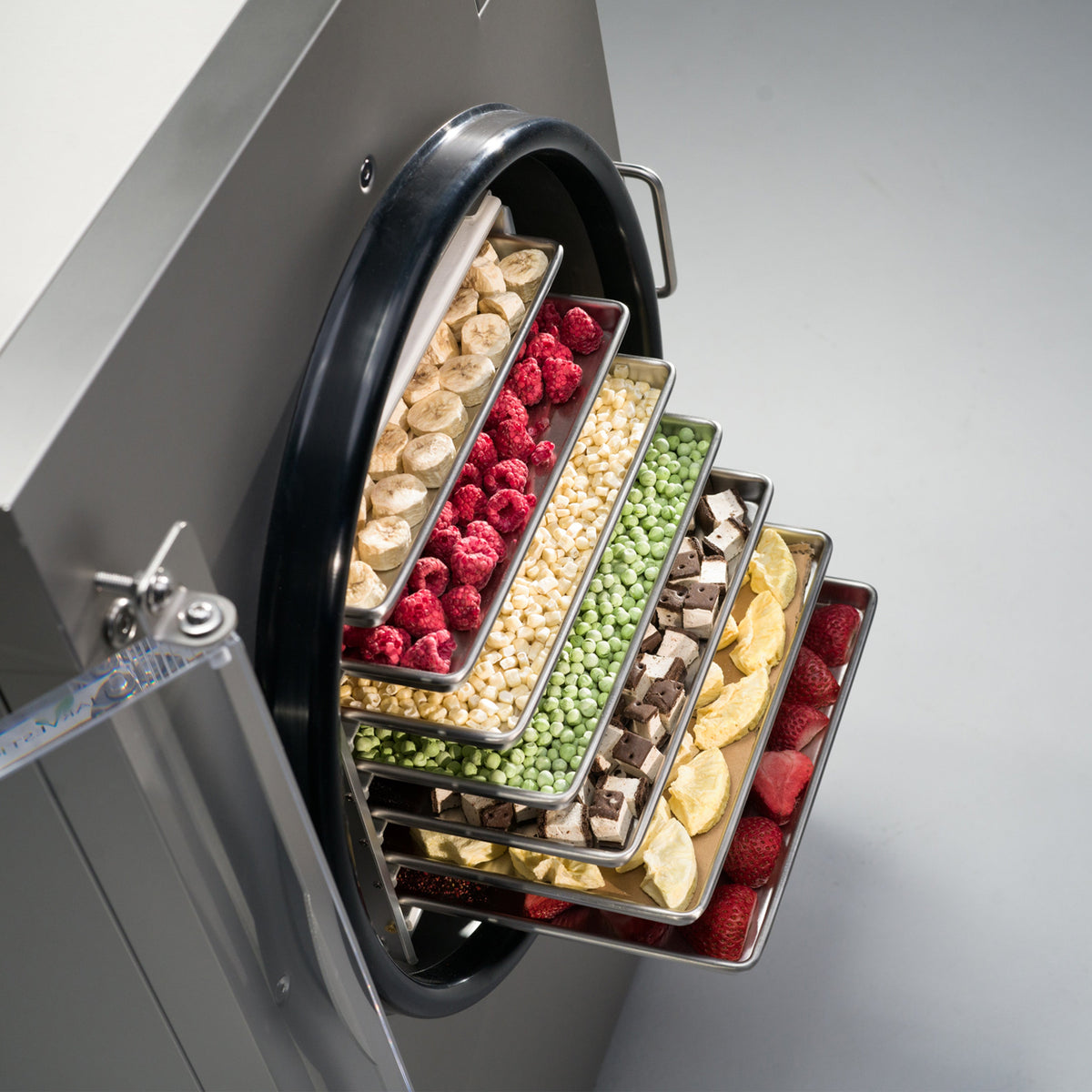
A Guide to Choosing the Right Home Freeze Dryer
The best freeze dryer size isn't necessarily the largest one you can afford. It's the model that matches how much food you expect to preserve, how often you plan to run batches, how much space you have, and how your needs may change over time.
Harvest Right's current home lineup includes Small, Medium, Large, and X-Large models. Current batch capacities range from approximately 6–10 pounds of fresh food per batch for the Small to 40–50 pounds for the X-Large.
A simple way to compare the current lineup is:
|
Model |
Fresh Food per Batch |
Trays |
Total Tray Space |
|
Small |
6–10 lbs. |
4 |
434 sq. in. |
|
Medium |
10–15 lbs. |
5 |
675 sq. in. |
|
Large |
18–27 lbs. |
6 |
1,107 sq. in. |
|
X-Large |
40–50 lbs. |
7 |
2,251 sq. in. |
Actual batch size can vary depending on the type of food, moisture content, preparation, and how heavily the trays are loaded.
Household size can be a useful starting point when choosing a freeze dryer, but it isn't the only thing that matters. A family with a large garden, for example, may need significantly more capacity than a similarly sized family that primarily wants to freeze dry occasional meals and snacks.
Quick Answer: What Size Freeze Dryer Should I Buy?
Start by asking four questions:
How much food do I want to freeze dry at one time?
How often will I realistically run the machine?
What types of food will I preserve?
Where will the freeze dryer and vacuum pump be installed? (using the word 'installed' makes me think I have to actually install this thing somewhere. But really you just need a dedicated space)
Someone preserving occasional meals and snacks has very different capacity needs from someone processing a large garden, buying meat in bulk, preparing food for camping or hunting, building a substantial food supply, running a small business, or operating the freeze dryer several times each week.
The right freeze dryer is the one whose capacity matches how you expect to use it.
Why Freeze Dryer Size Matters
It's easy to focus primarily on purchase price when comparing freeze dryers, but size affects much more than price.
It determines:
-
How much food fits in each batch
-
Number and size of trays
-
Amount of tray space
-
Physical footprint
-
Machine weight
-
Electrical requirements
-
Where you can install it
-
How many batches you may need to run
-
How quickly you can process a seasonal harvest or large purchase
A freeze dryer that's larger than you need can take up unnecessary space. One that's too small may leave you constantly running additional batches because you have more food waiting than available tray space.
The goal is to find the right balance for how you expect to use your freeze dryer.

Harvest Right Freeze Dryer Sizes at a Glance
Small Home Freeze Dryer
Harvest Right currently rates the Small for approximately 6–10 pounds of fresh food per batch, with four trays and 434 square inches of tray space.
The current published exterior dimensions are approximately:
17.4" W × 21.5" D × 26.8" H
The freeze dryer itself weighs about 91 pounds and operates from a 110V outlet.
A Small may be a good fit if:
-
You're an individual, couple, or small household of about 1–3 people
-
You expect to run relatively small batches
-
You have a small garden or regularly buy fresh produce
-
You like making healthy snacks
-
You want to make meals, candy, or pet treats
-
You occasionally camp or backpack
-
You want to start building a food supply
-
You don't regularly have large amounts of food to preserve
-
Available installation space is a major consideration
-
You're starting a small freeze-dried food or treat business and don't need large production runs yet
Think twice about the Small if:
You already know you intend to preserve large quantities of garden produce, meat, complete meals, or bulk food regularly.
You can run more batches, but at some point, repeated batches become less convenient than having more tray capacity.
Medium Home Freeze Dryer
The Medium currently handles approximately 10–15 pounds of fresh food per batch and provides five trays with about 675 square inches of total tray space.
That additional capacity can make an important difference for households that expect to freeze dry regularly without moving into the capacity and footprint of the larger machines.
A Medium may be a good fit if:
-
You have a family of about 2–5 people
-
You plan to preserve food regularly
-
You have a small garden or regularly bring home fresh produce
-
You occasionally buy food in bulk or have extra food to preserve
-
You camp, backpack, hunt, or spend time outdoors
-
You want to make meals, snacks, outdoor meals, or pet treats
-
You want to build a good-sized food supply
-
You want more capacity without committing to very large batches
For many families, the Medium can provide a useful balance between everyday flexibility and additional capacity.
Large Home Freeze Dryer
Harvest Right currently rates the Large at approximately 18–27 pounds of fresh food per batch, with six trays and about 1,107 square inches of tray space.
That's a substantial jump from the Medium.
Filling six larger trays takes more food and more preparation, but that's also where the Large can be particularly useful. If you're bringing in a large garden harvest, processing food from a hunting trip, buying in bulk, or putting away a substantial amount of food, the additional capacity can reduce the number of batches you need to run.
A Large may be a good fit if:
-
You have a larger family of about 4–8 people
-
You have a medium to large garden
-
You regularly buy food in bulk
-
You hunt, camp, backpack, or take extended outdoor trips
-
You frequently have more food than you can use fresh
-
You want to build a large food supply
-
You regularly preserve larger amounts for your family or pets
-
You prefer fewer, larger batches instead of running smaller batches more frequently
-
You expect the freeze dryer to run frequently
-
You have a growing business and need substantially more production capacity
The Large is especially worth considering when your food arrives in bursts.
A garden is a good example. Tomatoes, corn, peppers, berries, zucchini, and other crops don't necessarily mature according to your freeze dryer's schedule. When harvest season peaks, additional tray capacity can reduce the amount of food waiting to be processed.

X-Large Home Freeze Dryer
The X-Large is a significant step up in capacity.
Harvest Right currently rates it for approximately 40–50 pounds of fresh food per batch, with seven trays and 2,251 square inches of total tray space.
The current published machine weight is about 258 pounds, so placement should be planned carefully.
With seven large trays, it takes a significant amount of food and preparation to fill an X-Large batch. For someone with a large garden, fruit trees, frequent bulk purchases, serious food-storage goals, or a business, that's exactly the advantage.
An X-Large may be a good fit if:
-
You have a large family of 5 or more
-
You have a large garden, fruit trees, or both
-
You regularly bring in large harvests
-
You buy or prepare food in large quantities
-
You hunt, camp, or prepare food for extended trips
-
You want to build a significant long-term food supply
-
You prepare substantial amounts of food for your family or pets
-
You want to process as much food as possible in each batch
-
You have a business and need serious production capacity
The X-Large isn't necessarily the best choice simply because bigger sounds better. It requires more space and provides considerably more capacity than many households need.
Don't Choose Based on Household Size Alone
Household size can help point you in the right direction, but it doesn't tell the whole story.
How much food you grow, buy, prepare, and preserve matters just as much. If you plan to share the freeze dryer with another household or family member, you'll also want to consider the combined amount of food you may be processing.
Consider two families of four.
Family A
-
No garden
-
Freeze dries occasional meals and leftovers
-
Makes fruit snacks
-
Occasionally prepares camping meals
Family B
-
Has a large garden
-
Raises chickens
-
Buys meat in bulk
-
Preserves complete meals
-
Builds long-term food storage
-
Runs batches frequently during harvest season
They have the same household size, but their capacity needs are very different.
That's why household size is best considered alongside how much food you expect to preserve and how frequently you expect to use your freeze dryer.

Question 1: How Much Food Do You Expect to Preserve?
This is probably the most important question.
Don't think only about how much freeze-dried food you eventually want to have. Think about how much fresh food you're likely to have waiting to go into the freeze dryer.
Occasional use
You might freeze dry:
-
Leftover meals
-
Strawberries and other fruit
-
Yogurt
-
Candy
-
A few trays of garden produce
-
Pet treats
A smaller freeze dryer may be perfectly adequate.
Regular household use
You might freeze dry:
-
Weekly meals or leftovers
-
Bulk grocery purchases
-
Fruit and vegetables
-
Eggs
-
Snacks and pet treats
Medium or Large may provide more convenient capacity.
High-volume use
You might regularly process:
-
Large garden harvests
-
Fruit from trees
-
Bulk meat
-
Large quantities of prepared meals
-
Significant amounts of food for long-term storage
-
Food or treats for a business
That may push the decision more toward Large or X-Large.
Question 2: How Often Will You Run Your Freeze Dryer?
Capacity per batch tells only part of the story. Frequency matters too.
If you have a large amount of food to process, you may be able to handle it with several smaller batches or fewer larger batches.
Neither approach is necessarily wrong. The question is how frequently you want to run your freeze dryer and how much food is likely to be waiting between batches.
Someone who freeze dries occasionally may not care if a project requires multiple batches. Someone trying to process a large amount of ripe produce during harvest season probably will.
Question 3: What Foods Will You Freeze Dry?
The foods you plan to freeze dry can influence how quickly you use the available tray space.
Some foods can be spread efficiently across the trays, while sliced fruit, larger pieces of food, complete meals, or foods that require additional spacing may use available tray area differently.
That's why tray space can be just as useful a comparison as pounds per batch. The food itself affects how efficiently the available space can be used.
Question 4: Do You Garden?
Gardeners should think about peak harvest, not just average weekly use.
For much of the year, a smaller freeze dryer might appear sufficient. Then harvest season arrives and tomatoes, zucchini, corn, peppers, berries, green beans, herbs, and other foods may all be ready around the same time.
If preserving garden harvests is one of your primary reasons for buying a freeze dryer, additional batch capacity can be particularly valuable.
Related Learning Center guide: How to Freeze Dry Your Garden Harvest
Question 5: Do You Buy Food in Bulk?
If you regularly buy meat, fruit, produce, or other foods in bulk, think about how much of that food you might want to freeze dry at one time.
A larger freeze dryer allows you to process more of a bulk purchase in each batch and can reduce the number of batches required.
Question 6: Are You Freeze Drying Complete Meals?
Complete meals are one of the most practical uses of a home freeze dryer.
You might freeze dry:
-
Chili
-
Soup
-
Pasta
-
Casseroles
-
Rice dishes
-
Breakfasts
-
Leftovers
-
Camping meals
Meal preparation can use available tray space quickly. Someone who regularly makes a large batch of a family meal and freeze dries part of it may benefit more from additional capacity than someone primarily making small amounts of fruit snacks or treats.
Question 7: How Much Space Do You Have?
Decide where your freeze dryer will go before choosing a size.
Depending on the model and your setup, consider:
-
Freeze dryer footprint
-
Vacuum pump placement
-
Door clearance
-
Airflow
-
Working space
-
Tray loading and unloading
-
Electrical outlet location
-
Drain hose
-
Machine weight
-
Access for cleaning and maintenance
A pantry, laundry room, spare room, utility area, or garage may all be possibilities depending on the space and operating conditions.
Measure your intended location and make sure you'll have enough room to comfortably operate and maintain the freeze dryer.
Question 8: What Electrical Service Is Available?
Electrical requirements should be verified for the exact model before purchasing.
Harvest Right models don't all have identical electrical requirements. Don't assume that because one model works with an existing outlet, every model will.
Check the voltage, amperage, dedicated-circuit requirements, and outlet type for the exact freeze dryer you're considering.
If you're unsure whether your space has the appropriate electrical service, consult a qualified electrician.
Should I Buy One Size Larger Than I Think I Need?
If you find yourself between two sizes, we typically recommend sizing up.
Many owners discover more foods they want to preserve once they begin using their freeze dryer. You may initially plan on fruit and food storage and later find yourself freeze drying meals, garden produce, pet treats, eggs, meat, snacks, bulk purchases, and more.
Moving up a size can give you additional capacity as your use grows and can reduce the number of batches you need to run.
That doesn't mean everyone needs the largest freeze dryer possible. Make sure you have the space, electrical service, and enough food to make practical use of the larger model.
What If I'm Between Two Sizes?
If you're still deciding between two models, ask yourself:
How often would I completely fill the smaller freeze dryer?
If the answer is almost every batch, the larger model is probably worth serious consideration.
Do I have room for the larger model?
Capacity only helps if you have an appropriate place to install and use the freeze dryer.
Is my use seasonal?
Gardeners, hunters, and people who buy or preserve seasonal foods may need considerably more capacity during certain times of year.
Do I expect my use to grow?
Think about what you freeze dry today, but also what you're realistically likely to freeze dry once you have the machine.
Which would bother me more: running additional batches or dedicating more space to a larger freeze dryer?
That answer can make the decision much clearer.
Think About Your Busiest Time of Year
Don't size your freeze dryer around your quietest month.
If you garden, hunt, buy seasonal produce, or preserve larger quantities of food during particular times of year, think about how much food you'll have waiting when you're busiest.
A freeze dryer that feels plenty large enough during a normal week may feel very different when your garden is producing heavily or you come home with a large amount of food to process.
Which Harvest Right Freeze Dryer Is Best?
There isn't one model that's best for everyone.
Consider the Small if you have a household of about 1–3 people, your batch volume is modest, and space is important.
Consider the Medium if you have a household of about 2–5 people, expect regular use, and want more capacity without moving into very large batches.
Consider the Large if you have a household of about 4–8 people, a larger garden, bulk purchases, hunting or outdoor needs, substantial food-storage goals, or a growing business and want to process more with each batch.
Consider the X-Large if you have a large household of 5 or more, regularly have large quantities of food to preserve, or have a business or other high-volume processing needs.
As you move up through the sizes, you're not really changing what you can freeze dry. You're changing how much you can freeze dry at once.
Think about how much food you're likely to have, how often you want to run batches, where the freeze dryer will go, and how you see yourself using it in the future.
And if you find yourself between two sizes, we typically recommend sizing up. It gives you room to grow as you discover just how many things you can freeze dry.
Condividi:
How Much Food Should You Put in a Harvest Right Freeze Dryer?
How to Prepare Food for Freeze Drying: Cutting, Pre-Freezing, Blanching & Tray Loading