

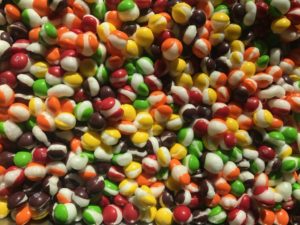
Les Skittles lyophilisés constituent l'un des exemples les plus spectaculaires — et les plus amusants — de ce qui se passe lorsqu'on place des bonbons dans un lyophilisateur.
Les Skittles classiques sont petits, denses et moelleux sous leur enveloppe dure. Après lyophilisation, ils deviennent plus gros, plus légers, aérés et extrêmement croquants. L’enveloppe se fissure souvent à mesure que le cœur se dilate, donnant naissance à ces bonbons colorés et gonflés qui ont connu un tel succès.
Et si vous disposez d'un lyophilisateur à usage domestique, vous pouvez les préparer vous-même.
Dans ce guide, nous vous expliquerons comment lyophiliser des Skittles, ce qui leur arrive pendant le processus, pourquoi ils gonflent, comment obtenir de meilleurs résultats et quoi faire lorsqu'un lot ne donne pas le résultat escompté.
Que sont les Skittles lyophilisés ?
Les Skittles lyophilisés sont des Skittles classiques qui ont été traités dans un lyophilisateur.
Ce procédé modifie radicalement leur texture. Au lieu du cœur moelleux auquel on est habitué, les Skittles lyophilisés deviennent croustillants et légers. Beaucoup gonflent au point de fissurer leur enveloppe extérieure, ce qui donne à chaque bonbon une forme différente.
La saveur peut également paraître plus intense en raison du changement radical de texture et de la façon dont le bonbon fond et se désagrège dans la bouche.

Skittles classiques vs Skittles lyophilisés
| Caractéristique | Skittles classiques | Skittles lyophilisés |
|---|---|---|
| Texture | Moelleux | Léger et croustillant |
| Taille | Petit et compact | Se développe généralement |
| Coquille | Lisse et intact | Il se fissure souvent lorsque les bonbons gonflent |
| Centre | Dense et moelleux | Croustillant et léger |
| Expérience gastronomique | Moelleux | Croquant et à dissolution rapide |
| Aspect | Uniforme | Gonflé, craquelé et parfois irrégulier |
Cette transformation fait en grande partie tout l'attrait de cette friandise. On part d'un bonbon familier pour aboutir à quelque chose dont l'aspect et la texture sont complètement différents.
Comment lyophiliser des Skittles
La lyophilisation des Skittles est relativement simple grâce à un lyophilisateur domestique Harvest Right.
1. Préparez vos Skittles
Ouvrez l'emballage et séparez les pièces qui seraient collées les unes aux autres.
En général, il n'est pas nécessaire de couper les Skittles avant de les lyophiliser.
Vous pouvez lyophiliser plusieurs saveurs ensemble, ou les trier par couleur si vous souhaitez comparer le résultat obtenu.
2. Disposez-les sur les plateaux
Répartissez les Skittles sur les plateaux du lyophilisateur.
Laissez-leur suffisamment d'espace pour qu'ils puissent gonfler sans que tout le plateau ne se transforme en une masse compacte de bonbons.
Un tapis en silicone ou du papier sulfurisé spécialement conçu pour vos moules peut également faciliter le nettoyage lorsque vous préparez des bonbons.
3. Charger le lyophilisateur
Placez les plateaux dans votre Harvest Right et suivez les instructions en vigueur pour votre appareil et la version de votre logiciel.
Les bonbons se distinguent des aliments à forte teneur en eau, tels que les fruits, la viande ou les plats complets ; veillez donc à suivre le processus adapté aux bonbons ou les recommandations actuelles de Harvest Right pour votre lyophilisateur, plutôt que de partir du principe que tous les aliments doivent être traités avec les mêmes réglages.
4. Laisser les bonbons cuire
C'est ici que la transformation s'opère.
Au fur et à mesure que les Skittles sont traités, leur cœur se dilate. Leur enveloppe extérieure dure peut se fendre, ce qui leur confère cet aspect gonflé et irrégulier caractéristique des Skittles lyophilisés.
Ne vous attendez pas à ce que tous les Skittles se ressemblent.
Certaines peuvent se fendre de manière spectaculaire. D'autres peuvent rester relativement rondes. C'est ce qui fait tout le charme.
5. Vérifiez les bonbons une fois prêts
Une fois cuits, les Skittles doivent être secs et croustillants, et non pas mous ou moelleux.
Laissez-les refroidir selon les besoins de votre recette, puis dégustez-les immédiatement ou emballez-les pour préserver leur texture et les protéger de l'humidité de l'air.
Faut-il congeler les Skittles au préalable ?
En général, il n'est pas nécessaire de congeler les Skittles au préalable, comme on le ferait pour d'autres aliments avant de les placer dans un lyophilisateur.
C'est pourquoi les bonbons constituent un moyen simple de s'essayer à la lyophilisation à domicile.
Toutefois, votre procédure doit respecter les recommandations propres à votre modèle Harvest Right et à la version actuelle de votre logiciel, en particulier si votre machine dispose de réglages spécifiques pour les bonbons.
Combien de temps faut-il pour lyophiliser des Skittles ?
Les bonbons peuvent être préparés beaucoup plus rapidement que de nombreux aliments lyophilisés traditionnels.
Cependant, il n'existe pas de durée universelle valable pour tous les lots de Skittles ni pour toutes les machines Harvest Right.
Le délai de traitement peut varier en fonction de plusieurs facteurs, notamment :
modèle de lyophilisateur
logiciels et processus sélectionnés
quantité de bonbons chargée
chargement par plateau
conditions de départ
conditions ambiantes
Au lieu de vous fier à une ancienne durée ou température trouvée sur Internet, suivez les instructions actuelles correspondant à votre modèle Harvest Right.
Opportunité de test « Harvest Right » : Nous menons actuellement des tests contrôlés afin de recenser les temps de traitement des Skittles sur l'ensemble des modèles Harvest Right actuels. Ce guide pourra être mis à jour en fonction de ces résultats, afin que les propriétaires disposent de données réelles sur les lots plutôt que d'estimations.

Pourquoi les Skittles gonflent-ils lorsqu'ils sont lyophilisés ?
C'est l'une des étapes les plus intéressantes de la lyophilisation des bonbons.
Les aliments traditionnels contiennent des quantités importantes d'eau. Lors de la lyophilisation, l'eau congelée est éliminée par un processus appelé sublimation, au cours duquel la glace se transforme en vapeur d'eau sans passer par l'état liquide.
Les bonbons se comportent un peu différemment, car leur composition est très différente de celle d'aliments tels que les fraises ou la viande.
Au cours de leur transformation, la structure interne de certains bonbons peut se dilater considérablement sous l'effet du vide. Dans le cas des Skittles, cette dilatation peut exercer une pression sur l'enveloppe extérieure dure jusqu'à ce que celle-ci se fende.
On obtient ainsi le célèbre Skittle gonflé et lyophilisé.
Les compositions des bonbons variant d'un produit à l'autre, tous les types de bonbons ne réagissent pas de la même manière.
Certains bonbons gonflent énormément.
Certains deviennent plus légers et plus croustillants sans gonfler beaucoup.
Et certains bonbons ne se prêtent tout simplement pas à la lyophilisation.
C'est l'une des raisons pour lesquelles s'amuser avec des bonbons peut être tellement sympa.
Pourquoi les Skittles lyophilisés ont-ils un goût différent ?
La lyophilisation ne donne pas aux Skittles une nouvelle saveur, mais elle transforme complètement l'expérience gustative.
Pour déguster un Skittle classique, il faut mâcher sa coque dure et son cœur dense.
Un Skittle lyophilisé est beaucoup plus cassant. Il se fissure et s'émiette rapidement dès qu'on le mord.
Ce changement de texture peut faire ressortir davantage les saveurs familières, à la fois sucrées et acidulées.
Pour beaucoup de gens, le croquant est la principale raison pour laquelle ils préfèrent les Skittles lyophilisés aux bonbons originaux.
De combien les Skittles gonflent-ils ?
Les Skittles peuvent gonfler considérablement pendant leur transformation, mais tous les bonbons ne gonflent pas exactement dans les mêmes proportions.
La version originale de cet article indiquait que les Skittles doublaient de volume. Bien que chaque bonbon puisse gonfler considérablement, nous estimons qu'il ne faut pas donner de chiffre général sans préciser exactement comment cette mesure a été effectuée.
La meilleure façon de répondre à cette question est de la mesurer.
Un test contrôlé permet d'enregistrer :
| Mesure | Avant la lyophilisation | Après la lyophilisation |
|---|---|---|
| Nombre de Skittles | — | — |
| Poids total | — | — |
| Diamètre moyen | — | — |
| Taille moyenne | — | — |
| Volume moyen | — | — |
| La plus grande expansion | — | — |
Une fois les tests effectués, nous pouvons calculer le pourcentage moyen de variation.
Cela offre aux propriétaires de lyophilisateurs à usage domestique un argument plus convaincant que de simplement dire que les Skittles « grossissent ».
À quoi ressemblent les Skittles lyophilisés ?
Ne vous attendez pas à obtenir des morceaux parfaitement ronds comme ceux que vous avez versés du sachet.
Les Skittles lyophilisés peuvent prendre toutes sortes de formes.
Certaines se fissurent net au milieu.
Certaines se séparent de manière spectaculaire.
Certaines prennent une forme presque sphérique.
D'autres s'épanouissent de manière irrégulière et ressemblent à de petites explosions colorées.
Ce n'est pas forcément un problème si un Skittle ne ressemble pas exactement à un autre.
Ces formes irrégulières contribuent à rendre ces bonbons lyophilisés si intéressants.
Peut-on lyophiliser ensemble différentes saveurs de Skittles ?
Oui. On peut généralement mettre des Skittles de différentes saveurs sur le même plateau.
Vous pouvez les mélanger tels quels, comme ils se trouvent dans l'emballage, ou séparer les couleurs avant de les travailler.
Les séparer peut donner lieu à une expérience amusante.
Essayez de traiter le même nombre d'unités de chaque saveur et comparez :
expansion
forme
crunch
intensité gustative perçue
Vous constaterez peut-être que vous avez désormais une saveur lyophilisée préférée qui n'était pas votre préférée dans le sachet d'origine.
Peut-on lyophiliser différents types de Skittles ?
Il existe de nombreuses variétés de Skittles et des saveurs en édition limitée, et les découvrir fait partie du plaisir.
Il se peut que différentes formulations ne se comportent pas de la même manière dans un lyophilisateur.
Si vous testez une variété que vous n'avez jamais lyophilisée auparavant, commencez par une petite quantité et veillez à laisser suffisamment d'espace entre les morceaux pour qu'ils puissent se dilater.
Notez ce qui se passe.
Si vous possédez un lyophilisateur, faire des essais est l'un des meilleurs moyens de découvrir comment se comportent différents aliments et bonbons.
Peut-on lyophiliser des Skittles avec d’autres bonbons ?
Vous pouvez essayer différents bonbons, mais n'oubliez pas qu'ils ne se comportent pas tous de la même manière.
Parmi les bonbons populaires que les gens aiment tester, on trouve :
Skittles
caramel à l'eau salée
Nerds Gummy Clusters
Jolly Ranchers
bonbons gélifiés
guimauves
bonbons aux fruits moelleux
Certaines se développent beaucoup plus que d'autres, c'est pourquoi l'espacement entre les plateaux revêt une grande importance.
Si vous testez une nouvelle recette, réaliser des petites quantités à titre d'essai peut vous aider à comprendre le comportement de chaque bonbon avant de remplir un plateau entier.

Pourquoi mes Skittles lyophilisés n'ont-ils pas gonflé ?
Un lot qui ne ressemble pas exactement à une photo publiée sur Internet n'est pas forcément un échec.
Les résultats peuvent varier selon les bonbons.
Si vos Skittles ne se sont pas gonflés comme prévu, pensez à vérifier les points suivants :
Le processus sélectionné.
Assurez-vous de respecter les recommandations en vigueur concernant les bonbons ainsi que celles spécifiques à votre modèle Harvest Right.
Chargement des plateaux.
Les éléments trop serrés peuvent entrer en collision les uns avec les autres lorsqu'ils se dilatent.
Formulation de bonbons.
Les différentes variétés et formulations peuvent présenter des comportements différents.
Conditions de départ.
La température et d'autres conditions de traitement peuvent influencer les résultats.
Attentes.
Les Skittles ne prendront pas tous exactement la même forme parfaitement ronde.
Si l'ensemble du lot présente un comportement inattendu, consultez le mode d'emploi actuel de Harvest Right avant de modifier les paramètres en suivant des conseils destinés à un autre modèle ou à une autre version du logiciel.

Pourquoi mes Skittles lyophilisés sont-ils encore moelleux ?
La texture caractéristique des Skittles lyophilisés est croustillante plutôt que moelleuse.
Si les vôtres restent étonnamment mous ou moelleux, vérifiez d'abord si cela est normal pour la variété de bonbons que vous préparez.
Pour les Skittles classiques, une texture qui reste molle peut indiquer que la fabrication du lot ne s'est pas déroulée comme prévu ou que les bonbons ont été exposés à l'humidité après leur fabrication.
En cas de doute, ne conditionnez pas un lot suspect en vue d'un stockage de longue durée.
Vérifiez les instructions d'utilisation de votre machine ainsi que les conditions de traitement, et effectuez des traitements supplémentaires si cela s'avère nécessaire pour votre machine et votre produit.
Pourquoi mes Skittles se sont-ils collés les uns aux autres ?
Les Skittles peuvent gonfler pendant leur transformation.
Si elles sont trop serrées les unes contre les autres avant le début du cycle, les pièces qui se dilatent risquent de se toucher ou de se heurter les unes aux autres.
En laissant suffisamment d'espace entre les morceaux, il sera plus facile de séparer les bonbons les uns des autres par la suite.
L'espacement revêt une importance encore plus grande lors du traitement de bonbons connus pour gonfler considérablement.
Comment conserver les Skittles lyophilisés ?
Si vous comptez les déguster peu après leur préparation, placez les Skittles une fois prêts dans un récipient hermétique afin de préserver leur croustillant.
L'humidité est l'ennemie de cette texture légère et croustillante que l'on apprécie tant dans les bonbons lyophilisés.
Pour un stockage de longue durée, utilisez un emballage adapté à la durée et aux conditions de stockage.
Il existe toutefois une distinction importante entre les bonbons et les aliments que l'on lyophilise pour les conserver à long terme:
La plupart des gens ne se mettent pas à lyophiliser des Skittles parce qu'ils ont besoin de faire des réserves de bonbons pour plusieurs décennies en cas d'urgence.
Ils le font parce que c'est amusant de les préparer et de les déguster.
Dans ce cas précis, l'objectif est avant tout d'empêcher l'humidité de ramollir vos bonbons croustillants.
Quelle est la durée de conservation des Skittles lyophilisés ?
La réponse dépend fortement des conditions d'emballage et de stockage.
Plutôt que d'attribuer aux Skittles lyophilisés les mêmes allégations de durée de conservation que celles utilisées pour les denrées alimentaires de base correctement conditionnées, réfléchissez à la manière dont vous comptez réellement les utiliser.
Pour les friandises qui seront consommées assez rapidement, un récipient hermétique peut aider à préserver leur texture.
Pour un stockage de longue durée, les emballages doivent offrir une meilleure protection contre l'humidité et les conditions environnementales.
Et si vous commercialisez des bonbons lyophilisés, veillez à respecter toutes les exigences applicables en matière de manipulation des denrées alimentaires, de conditionnement, d'étiquetage et de réglementation locale.
Skittles lyophilisés ou Skittles classiques : lesquels sont les meilleurs ?
C'est tout à fait subjectif.
Si vous aimez la texture moelleuse bien connue des Skittles classiques, la version originale restera peut-être votre préférée.
Si vous aimez les bonbons croquants, les Skittles lyophilisés vous feront découvrir une expérience totalement différente.
C'est justement ce qui en fait une excellente première expérience en matière de confiserie.
Vous n'essayez pas de conserver un ingrédient rare ni de sauver la récolte de votre potager.
Vous prenez un produit familier et vous observez l'effet que la lyophilisation a sur celui-ci.
Et le résultat saute aux yeux dès la première bouchée.
Quels autres bonbons devriez-vous lyophiliser ?
Une fois que vous aurez créé des Skittles, il y a de fortes chances que vous ayez envie de voir ce qui se passe avec autre chose.
Parmi les bonbons qui se prêtent bien à l'expérimentation, on peut citer les caramels mous, les Nerds Gummy Clusters, les Jolly Ranchers, les bonbons gélifiés, les guimauves et d'autres friandises moelleuses.
Mais ils ne se comportent pas tous comme des Skittles.
C'est pourquoi nous avons élaboré un guide plus complet sur les meilleurs bonbons à lyophiliser, ainsi qu'un guide expliquant le principe de la lyophilisation des bonbons et les raisons pour lesquelles certains bonbons gonflent.
Ces ressources constituent la prochaine étape si vous êtes prêt à aller au-delà des Skittles.
Faites-en un test de dégustation
Voici une expérience toute simple à réaliser en famille, lors d'une fête ou pour tous ceux qui aiment s'amuser avec leur assiette.
Garde quelques Skittles du paquet d'origine.
Liofilisez le reste.
Comparez-les ensuite côte à côte.
Essayez de répondre à la question suivante :
Lequel a le goût le plus prononcé ?
Quelle texture préférez-vous ?
Quelle saveur change le plus ?
Quelle est la couleur qui s'étend le plus ?
Pouvez-vous deviner le parfum sans regarder ?
Vous pouvez même peser et mesurer les échantillons avant et après la lyophilisation, puis consigner les résultats.
C'est un moyen simple de transformer un sachet de bonbons en une petite expérience de lyophilisation.
Peut-on fabriquer des Skittles lyophilisés chez soi ?
Oui, mais il faut un lyophilisateur.
Un congélateur ménager classique permet de congeler les aliments, mais ne crée pas les conditions de vide et de séchage contrôlées nécessaires à la lyophilisation.
Un déshydrateur, ce n'est pas la même chose non plus. Les déshydrateurs utilisent principalement la chaleur et un flux d'air pour éliminer l'humidité et ne permettent pas d'obtenir ce résultat : des aliments gonflés et croustillants.
Un lyophilisateur domestique vous permet de réaliser le processus de lyophilisation chez vous.
Et même si les Skittles comptent sans doute parmi les choses les plus amusantes que l'on puisse y mettre, les bonbons ne représentent qu'une infime partie des utilisations que les gens font de leurs lyophilisateurs domestiques.
Cet appareil peut être utilisé pour les fruits, les légumes, les produits laitiers, les repas complets, les restes, les en-cas, les produits du potager et bien d'autres aliments.

Foire aux questions sur les Skittles lyophilisés
Qu'est-ce que les Skittles lyophilisés ?
Les Skittles lyophilisés sont des Skittles classiques qui ont été traités dans un lyophilisateur. Ils ont généralement tendance à gonfler, leur enveloppe extérieure se fissure et ils acquièrent une texture légère et croquante, contrairement à leur cœur moelleux d'origine.
Comment fait-on pour lyophiliser des Skittles ?
Disposez les Skittles sur les plateaux du lyophilisateur en laissant suffisamment d'espace pour qu'ils puissent se dilater, placez les plateaux dans votre lyophilisateur et suivez les instructions d'utilisation de votre appareil pour le traitement des bonbons. Une fois l'opération terminée, les Skittles devraient être secs et croustillants.
Faut-il congeler les Skittles au préalable ?
Les Skittles ne nécessitent généralement pas la même préparation préalable à la congélation que celle souvent requise pour d'autres aliments. Suivez les instructions en vigueur correspondant à votre lyophilisateur et à la version de votre logiciel.
Pourquoi les Skittles grossissent-ils lorsqu'ils sont lyophilisés ?
Lors du traitement sous vide, la structure interne du bonbon peut se dilater considérablement. Cette dilatation exerce une pression sur la coque dure et peut la faire se fissurer, ce qui lui donne cet aspect gonflé bien connu.
Combien de temps faut-il pour lyophiliser des Skittles ?
Il n'existe pas de durée de traitement universelle. Celle-ci dépend du lyophilisateur, du logiciel, du procédé choisi, de la quantité de bonbons, de la charge des plateaux et des conditions environnementales. Les bonbons se traitent généralement beaucoup plus rapidement que de nombreux aliments à forte teneur en eau.
Les Skittles lyophilisés sont-ils croustillants ?
Oui. Le cœur moelleux d'un Skittle classique subit une transformation importante au cours du processus de fabrication, ce qui lui confère cette texture légère et croustillante qui fait le succès des Skittles lyophilisés.
Est-ce qu'on peut lyophiliser toutes les saveurs de Skittles ?
Vous pouvez tester différentes saveurs et variétés de Skittles. Les compositions pouvant varier, ne partez pas du principe que toutes les variétés se comporteront de la même manière.
Peut-on lyophiliser des Skittles avec d'autres bonbons ?
Oui, mais chaque type de bonbon gonfle et se travaille différemment. Prévoyez suffisamment d'espace pour permettre cette expansion et pensez à réaliser de petits lots d'essai lorsque vous mélangez des bonbons que vous n'avez jamais travaillés ensemble auparavant.
Comment faire pour que les Skittles lyophilisés restent croustillants ?
Protégez-les de l'humidité. Si vous comptez les consommer assez rapidement, conservez-les dans un récipient hermétique. Pour une conservation plus longue, utilisez un emballage adapté.
Peut-on fabriquer des Skittles lyophilisés sans lyophilisateur ?
Pas de la même manière. Un congélateur ou un déshydrateur classique ne permet pas de reproduire le processus contrôlé de lyophilisation sous vide qui confère au produit sa texture gonflée et croquante caractéristique.
Bien plus que de simples Skittles
Les Skittles lyophilisés sont amusants, car la transformation est immédiate et évidente.
Versez le contenu d'un sachet de bonbons que vous connaissez bien sur les plateaux et vous obtiendrez un résultat qui a un aspect différent, une texture différente et un croquant tout à fait différent.
Mais c'est aussi ce qui fait des bonbons un excellent moyen de s'initier à la lyophilisation.
Après avoir vu ce qui arrive aux Skittles, on se pose naturellement la question suivante :
Puis-je lyophiliser des restes ?
Et les produits de mon potager ?
Est-ce que je pourrais préparer moi-même mes repas de camping ?
C’est là que l’expérience avec un sachet de Skittles peut permettre de découvrir tout ce dont un lyophilisateur domestique est réellement capable.
Commencez par quelque chose d'amusant.
Alors, continuez à faire des essais.
Partager:
Des légumes au petit-déjeuner : pour commencer l'année en pleine forme
Des légumes au petit-déjeuner : pour commencer l'année en pleine forme